THE FUTURE OF AGENTIC AI
in Finance and Banking
New York | Dec 10, 2026
ALD NYC | Schedule
Wednesday, May 13
8:30 – 9:55am ET
Registration Opens
9:55 – 10:00am ET
Anna Anisin - Founder, Data Science Salon, Moody Hadi - Head of AI Strategy and Execution, Enterprise Data Organization at S&P Global
10:00 – 10:30am ET
Pavan Kumar Gondhi - Sr Vice President at J P Morgan
Thanks for being here today. I’m Pavan Gondhi, with over 20 years of experience steering through digital shifts as an executive, and I want to share my take on AI; how it’s truly unlocking data’s game-changing potential.
By 2030, AI might pump $15.7 trillion into the global economy, all fueled by data. But honestly, too many companies are buried in data overload, stuck with silos and old systems that block real insights. AI flips the script, think machine learning nailing customer predictions, or generative AI revamping workflows in biopharma, mining, and finance, slashing costs and downtime.
The future? Thrilling: Federated learning democratizes data for things like personalized healthcare, plus dashboards tracking AI’s real-time impact. But we’ve got hurdles—biases, ethics, cyber threats, and job shifts mean we need strong governance and training.
Here’s my advice: Audit your data now, test AI pilots with solid metrics, and rally your teams. Let’s seize this and build a stronger tomorrow.
10:30 – 11:00am ET
Tharakesavulu Vangalapat - Sr. Principal Data Scientist & AI Architect at Broadridge
Agentic AI systems are moving rapidly from experimentation into enterprise production environments, where reliability, security, and governance matter as much as model capability. While large language models enable powerful reasoning and tool use, many early agent implementations struggle when exposed to real-world constraints such as inconsistent data, regulatory requirements, latency, and operational failure modes.
This talk explores how enterprises can design agentic AI systems that operate predictably and safely in production. Drawing from real deployment experience, it focuses on practical design patterns for planning loops, tool orchestration, and decision control, rather than prompt chaining or isolated demos. The session will examine how agents manage state, select actions, and recover from partial failures, as well as how guardrails—such as policy enforcement, observability, and human-in-the-loop controls—are implemented to reduce risk and maintain trust.
Attendees will gain a clear understanding of what differentiates experimental agents from enterprise-ready systems, along with concrete architectural considerations and lessons learned from deploying agentic AI in regulated, large-scale environments.
11:05 – 11:20am ET
Sanjay Mishra - Principal Software Engineer at Fidelity Investments
The data problems that drive this are real:
- Gaps in training data — if the model never saw reliable information on a topic, it fills the void with plausible-sounding noise.
- Noise and contradictions in the corpus — the web is full of misinformation, outdated facts, and conflicting claims. Models absorb all of it.
- Memorization vs. generalization — models sometimes over-generalize patterns, producing confident-sounding responses that have no factual basis.
11:20 – 11:40am ET
Keisuke Inoue - Senior AI/ML Engineer at Cape.AI
Unstructured operational directives often contain ambiguity, missing context, and hidden dependencies that make automation difficult. This session introduces a self-correcting agentic extraction framework built on a knowledge graph to automate trust operations workflows. The talk shows how schema-guided reasoning, structural and semantic validation, and iterative feedback loops enable agents to detect errors, reconcile inconsistencies, and refine outputs. Beyond the use case, the session highlights reusable design patterns for building reliable agentic systems for complex enterprise documents.
11:40 – 12:00am ET
Coffee Break
12:00 – 12:20pm ET
Kaushal Lahankar - Director of AI & Engineering at S&P Global
Abstract coming soon.
12:20 – 12:50pm ET
Santosh Durgam - Manager Of Software Engineering at Morningstar Investments Inc
Financial institutions want AI/ML at scale, but brittle data pipelines, silos, and compliance demands slow progress. This talk shows how a Data Mesh—domain-oriented ownership, data-as-product, self-serve platforms, and federated governance—becomes the foundation for reliable, reusable ML features and trustworthy models. We’ll map mesh principles to FS use cases—fraud detection, risk, personalization—and show patterns for feature stores, lineage, quality, and access controls that satisfy regulators while accelerating delivery. Attendees will get a pragmatic blueprint: where to start, how to sequence capabilities, metrics that prove value, and pitfalls to avoid on the road from pilots to production.
12:50 – 1:20pm ET
Shalini Sivasamy - Senior AI Engineer at New York Life
Phishing is a widespread cyber menace that has been used to exploit users on the digital communication platform by playing on psychological impulses and technical obfuscation to mislead users. The paper presents a hybrid model for phishing email detection based on Explainable Artificial Intelligence (XAI) methods, including SHAP, LIME, and attention visualisation. An 87.5% precision, 85.0% recall, and F1-score of 86.2% TF-IDF + Logistic Regression treated by a curated phishing dataset were trained on a lightweight model. The SHAP analysis indicated that words such as ‘urgent’, ‘click’, and ‘reset’ had a predictive weight of more than 60 per cent in phishing classification. Localised decision boundaries were emphasised by LIME explanations, whereas the high focus on manipulative phrases was emphasised by the simulated attention heatmaps. Further feature importance analysis indicated that email headers such as Reply-To and obfuscated URLs had a normalised influence score of 0.78 and 0.91, respectively. The suggested framework not only increases detection accuracy but also interpretability, which allows human-in-the-loop trust and actionable threat intelligence. These results enable the inclusion of XAI in the cybersecurity processes to provide efficient, transparent, and reliable phishing reduction.
1:20 – 1:40pm ET
DEEP PATEL - Senior Data Engineer at Robinhood
In today’s data-driven enterprises, making timely, accurate decisions requires transforming raw information into actionable insights at unprecedented speed. In “Real-Time at Scale,” I will explore how modern data platforms ingest, process, and act on streaming data, highlighting architectures and trade-offs that enable instantaneous decisions. Moving to “Analytics in the Age of LLMs,” I’ll demonstrate how generative AI and large language models are reshaping dashboards, metrics, and decision workflows, turning traditional reporting into dynamic, intelligent insight generation. Finally, “Proving AI ROI in the Enterprise” addresses the critical challenge of demonstrating measurable business impact from AI initiatives, outlining robust metrics that resonate with executives and boards. Attendees will gain practical strategies for architecting real-time pipelines, integrating AI into analytics responsibly, and measuring the tangible value of AI investments, leaving them equipped to accelerate data-driven decision-making across their organizations.
1:40 – 2:40pm ET
Lunch
2:40 – 3:00pm ET
Syam Dondapati - AVP at AIG
Abstract coming soon
3:00 – 3:45pm ET
Panel: Building Trusted Agentic AI Systems in Financial Services
Anna Jibgashvili - Corporate Vice President, Data Product Manager (AI & Data) at New York Life Insurance Company, Moody Hadi - Head of AI Strategy and Execution at S&P Global, Akhil Khunger - VP, Quantitative Analytics at Barclays, Mukesh Reddy Dhanagari - Manager, Software Development & Engineering at Charles Schwab, Nidhi Mahajan - Former Director of Product Program Management at VISA
Abstract coming soon
3:45 – 4:15pm ET
Nemo Dighe - Associate Director, Business Intelligence at group 1001
This talk outlines how financial services organizations can move beyond AI hype and build the foundations needed for real impact. It explains why many AI initiatives fail- due to poor data readiness, unclear business problems, and lack of adoption and introduces a practical four-step framework: defining the right business problem, aligning data and infrastructure, measuring success through business outcomes, and continuously improving through feedback. The focus is on treating AI not as a starting point, but as the result of a strong strategy, disciplined execution, and organizational readiness.
4:15 – 4:45pm ET
Harry Mendell - Data Architect, AI Group at Federal Reserve Bank, NY
From Code and Content to Insight and Action
Recent advances in AI have dramatically reduced the cost of generating code, analysis, and content. However, in financial systems and software engineering, the primary challenge is no longer production, it is quality. Faster and cheaper outputs do not necessarily translate into correct, reliable, or decision-relevant outcomes.
This talk focuses on how AI systems can be designed to improve the quality of outputs across the full pipeline, from code and data to analysis and decision-making. The objective is not to produce inexpensive approximations of human work, but to elevate standards: making outputs more accurate, more consistent, and more trustworthy.
We examine several technical limitations in current approaches and outline practical directions for improvement:
- Hierarchical and structural understanding
- Data quality, validation, and currency
- Semantic correctness in structured data
- Decision-aware reasoning and trade-offs
Across these examples, the central theme is that improving outcomes requires strengthening representation, validation, and reasoning—not simply increasing speed or scale. The next phase of AI is not about doing more, but about raising the standard of what is produced—enabling systems that support deeper insight, more reliable outputs, and higher-quality decisions
4:45 – 4:50pm ET
Anna Anisin - Founder, Data Science Salon, Moody Hadi - Head of AI Strategy and Execution, Enterprise Data Organization at S&P Global
5:00 – 7:00pm ET
Networking Reception
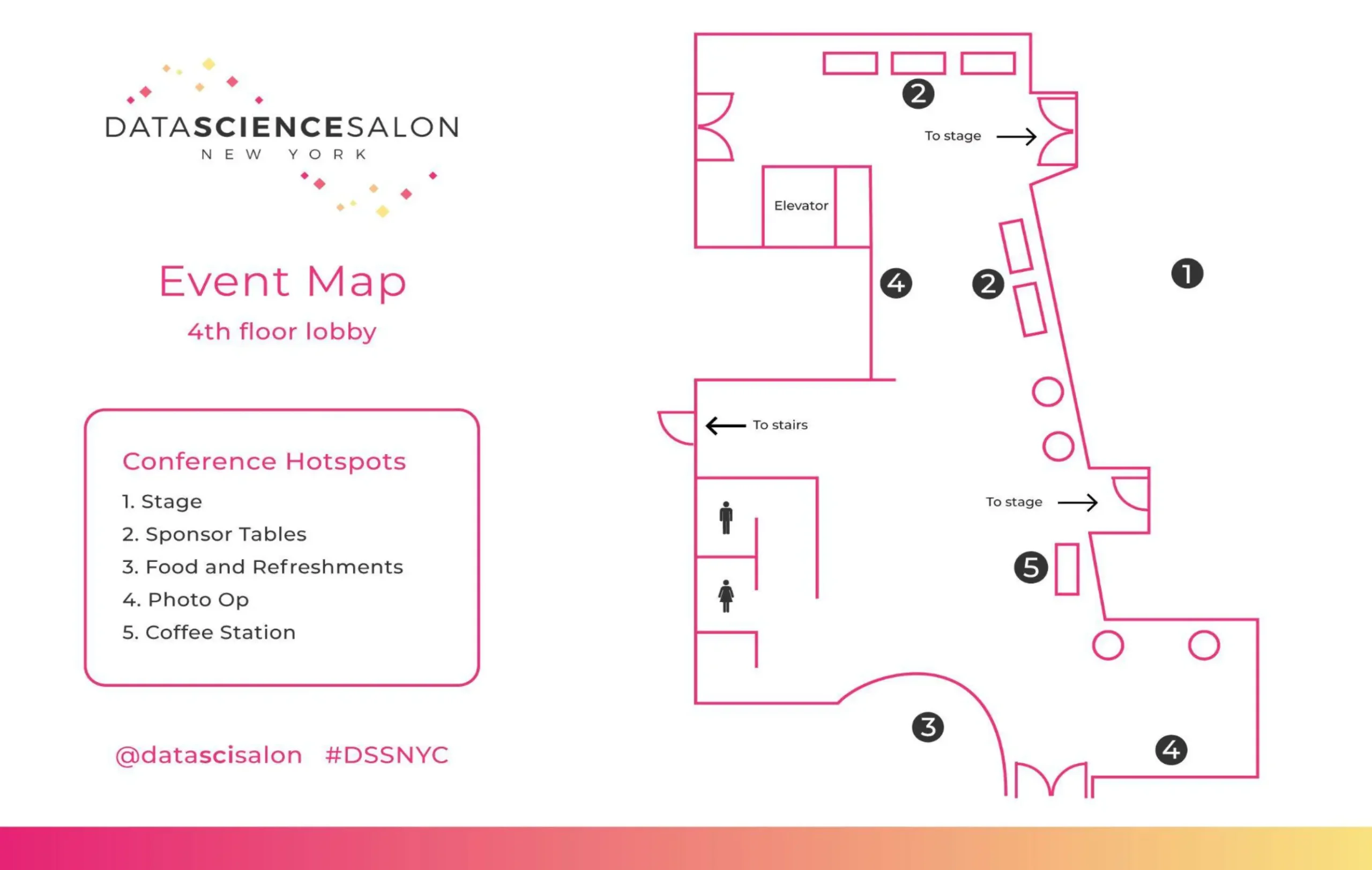
ALD NEW YORK EVENT MAP
Sponsored by


In partnership with