
With the .com boom of late 90’s and early 2000’s and wide adoption of email across the World, capturing the attention of users through an email was fairly easy compared to the current saturated digital space.
Increasing volume of promotional content within emails is leading to ever growing email fatigue and thus reducing the effectiveness and engagement of marketing emails. In such a state, marketers are competing to deliver personalized and timely content to users to drive engagement.
Considering the cost-effective nature of email marketing, it still depends on two key aspects to drive open rates and engagement – a) what the content of message says (subject lines) and also when it is said (send time).
Why Personalization Is No Longer Optional
Personalization of emails thus has become increasingly important to distinguish from blast and batch emails which do not take into account a user’s personal interest, behavior or context. To help drive personalization in email, we explore personalizing subject lines and send times using LLM and by using data-driven techniques and machine learning models to create engaging and effective email content to users.
Understanding User Behavior at Scale
Not all users are created equal and the user behavior varies across location, demographics and intent. Leveraging user behavior is key to personalizing content. This requires building predictive models using historical email data (what is the subject line, what is the tone of the sender, how a recipient responded to such emails in the past).
Key Behavioral and Contextual Signals
More explicit signals from the user in addition to user demographics, based on contextual signals like device type, timezone, engagement frequency, etc. are used to fine tune the predictions. For example, a user who opens email on their phone at lunch could benefit with a different subject line versus a user who opens emails at work throughout the day. Machine learning models integrating the above signals can provide a more accurate prediction of what would benefit the user the most.
How NLP and LLMs Improve Subject-Line Engagement
Studies have consistently shown that deeper personalization taking into account a user’s past history, browning behavior and device preference can result in more than double the open rates and click throughs. Additionally, campaigns that run on historical data, engagement outcomes, paired with subject lines with feelings, language, urgency, personalization indicators or even emojis using Natural Language Processing(NLP) driven models have shown to triple engagement rates. LLMs have now taken over the way work is imagined and done. These LLMs are integrated into the predictive modeling to provide sentiment scores, tone and predicted impact. Additionally time prediction models based on historical email open data are integrated into the process to provide synergistic enhancements on send time along with the subject line predictions.
Modeling Framework and System Architecture
The exact process involves a quantitative prediction design to gather and model large-scale user behavior patterns, historical data and user attributes. Bidirectional Encoder Representations from Transformers(BERT) which is an NLP based language understanding model used to understand language and predict how language is perceived by users along with Open AI’s GPT-2 were deployed to fine tune, classify and generate subject lines, learning tone, sentiment and structure correlated with engagement. Long Short Term Memory (LSTM) model which is specifically designed to remember information over long sequences retaining important signals and removing irrelevant noise are used to identify ideal email send time windows based on historical open times. This is paired with Prophet forecasting to predict send times for users whose historical information is not available (new users) using the global and seasonal trends.
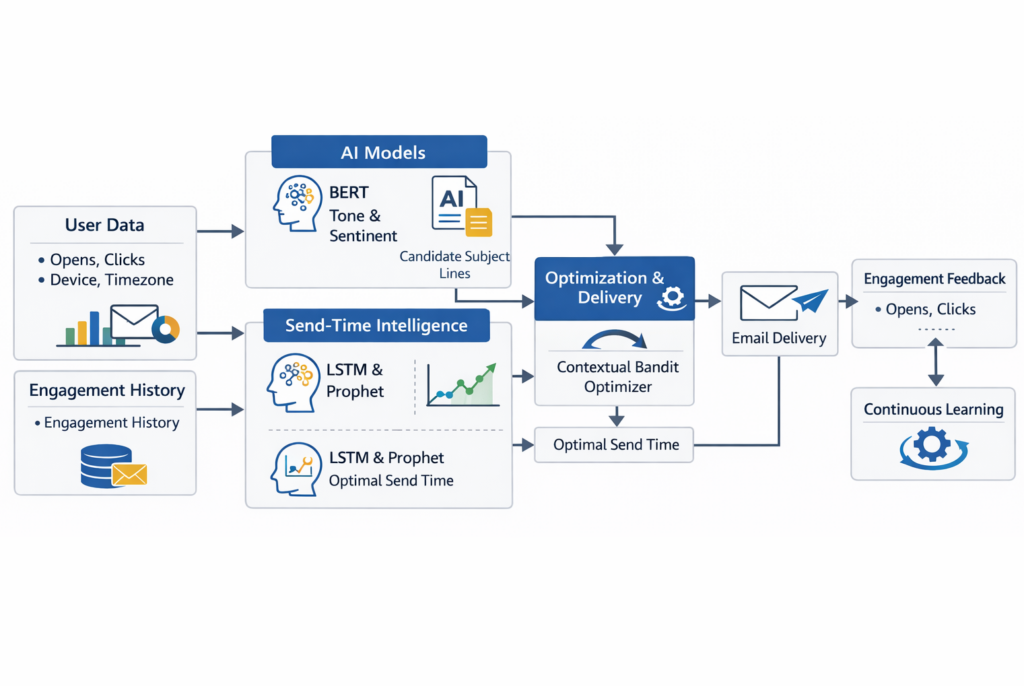
Figure 1, System Architecture for Personalized Email Engagement at Scale
Experimental Results and Performance Gains
The two models i.e. for subject line and send time optimization when tested individually in an A/B test against control showed an improvement of 17% and 22% higher open rates respectively. To jointly optimize content relevance and delivery timing, we employed a hierarchical contextual bandit framework. Send-time optimization was handled through predictive modeling, while subject-line selection was adaptively optimized within the predicted time window using a contextual bandit informed by real-time engagement feedback. The reinforcement learning nature of this model allows it to iterate and optimize the subject-lines and send times on the fly in production resulting in a 30% increase in open rates compared to the baseline.
Challenges in Large-Scale Personalization
Considerable challenges exist while implementing such models on large-scale systems. Since the model involves large volumes of historical user data to be processed to provide effective predictive outcomes. Additionally, sparse engagement histories of new users or cold-start users reduce predictive accuracy which requires more robust preprocessing pipelines and anomaly detection. Any user personalization increases a risk of overusing sensitive user data and raises privacy and ethical concerns and requires clearly defined boundaries on how the data is used and the ability for a user to control preferences of data use. Another challenge faced in such global large-scale implementation is the sensitivity to Time Zone and Locale which introduces issues related to cultural norms, region related engagement patterns and varying holiday and work schedules which influence optimal send-times and content tone.
Conclusion
ChatGPT and other LLM models can be effectively leveraged to personalize emails by using data driven techniques and machine learning algorithms thus allowing marketers to stand out in modern day inboxes and thus drive open rates, engagement and thus conversion.
Author : Preetham Reddy Kaukuntla